Saturday, July 2, 2016

New Outlander Style Pattern

Simplicity has come out with two new Outlander women's patterns, designed by American Duchess.  8162 is for underpinnings.  It includes a chemise, stays, and bum pad.  I like that the stays are front opening, although in my own research, I've seen more that are closed fronted.  Front lacing ones did exist, especially for women who had no one to assist them in dressing or were nursing.  8161  has the patterns for a jacket, stomacher, and petticoat.    

Two things to note in the design of these patterns: while they are inspired by the costumes in the first season of Outlander, American Duchess blended the designs with those found in extant garments from the 1740s. So, if you were wanting an exact replica of a costume from the show, these aren't it.  If you are good at tweaking patterns, I wouldn't think that they would be hard to modify.  The other thing to note is that they were designed for cosplay, not for hard core historical costumers.  Fear not!
 American Duchess is graciously putting out a series of blogs and videos to show people how to make them more historically accurate.  Thank you, Duchess!

For other historically accurate choices, see my previous blog on pattern suggestions from the first season of Outlander.  I guess I need to write another one for the more formal costumes shown in the Paris episodes of the second season.  Speaking of which, American Duchess is working on another pattern for Simplicity that is inspired the red dress in season 2.  Again, it won't be an exact replica, but will be based on gowns from that time and have a more elegant feel than 8161.


copyright Nellie Kampmann, 2016 


Sunday, August 24, 2014

Outlander Era Women's Costume Patterns


I'm sure I'm not the only one who has fallen in love with the costuming on Starz' production of Outlander.  It's not that unusual to see 18th century costuming in movies, but it is a nice change of pace to see costumes from before the American Revolution or what common folk wore.  I've been struck by the graceful simplicity of the designs.


Which of course means that I want to make one.  I'm so backlogged on my projects that realistically I won't get to that for a long time, but a costumer can dream, can't she?  

I've done some preliminary research on patterns and thought I would share that.  I will start with some relatively easy patterns for less experienced seamstresses, them move on to historically correct patterns for the hard core historical costumers.  Also, except as noted, I have not personally tried these patterns nor found reviews on them.  

Starting off with a pattern marketed towards sewers with average skills and who just want a general Scottish look, several years ago Simplicity came out with their Celtic collection, including 3623 for women.  It's more Renaissance fair than 1700s, but it's still charming.  It's currently out of print.  It surprises me that Simplicity did not reissue it in anticipation of  Outlander coming out.  They have a limited number of copies available on their website and you can also find more on Ebay and Etsy.  The pattern was previously released under the number 0663, so check for that also.

Period Impressions 1735-1740
Open Front Jacket
For the look in the above photo from the show, the only jacket pattern I have found for the 1740s, when Outlander is set, is the Period Impressions 1735-1740 Open Front Jacket.  I have never used a Period Impressions pattern before, but the sense I get from the Great Pattern Review of the Greater Bay Area Costumer's Guild is that they are usually pretty good.

J. P. Ryan A Fine Collection of Ladies' Jackets
J. P. Ryan had another good contender with their A Fine Collection of Ladies' Jackets.  I have used patterns by that company years ago and remember them as being pretty straightforward.  The earliest jacket in this collection is dated to 1750, but it does have the advantage of offering variations that are appropriate up to the early 1780s for other projects you might have in mind.  View C-D actually looks the most like the jacket in the Outlander photo, but J. P. Ryan dates it to a couple of decades later.

J. P. Ryan Women's Basic Garments
For the various underpinnings and skirt that go along with the outfit, J. P. Ryan has a nice set of Women's Basic Garments.  That includes a shift, petticoat, pocket, handkerchief, short gown, and apron.  My understanding is that only the short gown and pocket are actual patterns.  The rest are diagrams and instructions.  You could probably draft your own using instructions easily found on the internet, such as these instructions for a shift from La Couturiere Parisienne.  Tidings from the 18th Century by Beth Gilgun has diagrams and instructions for basic women's clothing, plus a wealth of other information.

Of course, one will also need a set of stays ("corset" to most modern folks) to get the proper silhouette.  Advanced costumers can use Mara Riley's instructions on how to modify the patterns from the Elizabethan Corset Generator to work for the 18th century form.  I've had good luck with the corset generator.  If the boning placement is not clear to you, there is a good diagram for that in Tidings from the 18th Century.  


If that sounds like too much of a challenge for you, there are plenty of stays patterns available.  Since the characters in Outlander were pretty active, you can use more lightly boned jumps instead of the more constricting full stays.  Those also come in front opening versions - much easier for us who live alone or have husbands who are at a loss at helping their wives get laced up.  Mill Farm offers a Jumps or Leather Stays pattern. My one experience working with a Mill Farm pattern, their Women's Riding Habit Jacket and Waistcoat, went extremely well.  Tailor's Guide has an even more lightly boned set in their Ladies' Partially Boned Stays pattern.  If you do want to go for a fully boned set of stays, I have used J.P. Ryan's strapless stays without problem. 

Finally, the aforementioned Mara Riley has a well regarded book out, Whatever Shall I Wear? A Guide to Assembling a Woman's Basic 18th C. Wardrobe, that goes into the specifics of color and fabric choices, accessories, etc. for working class women throughout the 18th century.  If you are going to spend all that time and money making a costume, you might as well get it right.  The Dress of the People: Everyday Fashion in Eighteenth-Century England by John Styles also sounds like a good resource.  Obviously, it focuses on England, not Scotland, but chances are that there are a lot of commonalities.

So, there you have it.  If you do try these patterns or have already used them, please let me know what you thought of them.

Update: Simplicity has come out with 2 Outlander style patterns for women.  I've written another blog with the details


copyright Nellie Kampmann, 2014

Monday, July 21, 2014

Some Tips on Making a Duct Tape Double


There are already several websites that will tell you how to make a duct tape double dress maker's dummy, so I won't get into all that here.  However, I did want to pass along a few tips I learned about the hard way while making mine.


  • Use a heavy duty duct tape.  I used Duck brand tape, which has a noticeably less sticky adhesive on it.  That would probably work OK for the first layer.  My problem was that I had used it to tape up the side seam after I had fit it over my old dressmaker's dummy.  I stuffed it, then didn't look at it again for a few days.  When I did see it again, the taped up side had burst open.  I re-taped it with Gorilla brand, which seems to be holding up much better.
  • Try the method that applies the strips in 6 inch lengths.  I had to make my double mostly without help, so I used longer strips to get my back done.  It's definitely harder to get smooth coverage that way.  I ended up with issues with the double creeping up because I was pulling the long strips too tight.
  • Apply the strips in various directions.  Again, this will help keep it from creeping.  Part of my problem was that I was applying the strips mostly horizontally.  Some instructions do tell you to do that. I think there would have been more control if the strips had followed the contours of my body more naturally.
  • It's ideal if you can get an old dress maker's dummy in a smaller size and use that for your base.  Of course you can make the dummy without one, but may be worth the cost in time and aggravation to pick up a used one at a thrift store.
  • When you tape the dummy back together after you've gotten out of it, place the tape horizontally so it will hold better. 
  • If you want to use the dummy for historical costuming, stuff it with batting instead of using the spray foam insulation method.  This will allow you to use corsets on it to maintain a period correct shape.
  • As you are stuffing the dummy, be sure to keep comparing it to your own body, especially if you aren't using an old dummy as a base.   If you do not have some form underneath to maintain the oval shape, the shell will tend to become rounded (if you look at it from a cross section), while most people's bodies are more oval.  Even with a form, you have to be careful to pad it in the right places.
  • Once the dummy is stuffed and mounted, make a form fitting cover for it from stretch knit fabric.  That will give it an extra layer that will be easier to pin into if the need arises and will look nicer, too.

copyright Nellie Kampmann, 2014

Saturday, May 31, 2014

Bustle Era Chemise

1883 linen chemise (reproduction)
I have been wanting an excuse to to make a cuirass form dress for decades now.  At one point, I made underpinnings for it, but never got further than that.  So, when I saw Jennifer Rosbrugh's Bustle Day Dress class being offered recently, I jumped at the chance. This class has been great so far (3 lessons in).  If you ever have a chance to take a class from her, do it!

I hit a bit of a road block right off the bat when I tried on the old underpinnings I had made.  The petticoat had gotten ruined at one point and as thrown out, and the combinations made from a Mantua Maker pattern no longer fit (oh, middle age spread, what have you done to me?!).  So, back to the sewing machine on those.

First up was making a chemise.  I don't know what the deal is, but the ones I have made in the past from Simplicity patterns have always ended up huge.  Either they were what I found out later were more suitable for 1830s/1840s fashions, or were just plain sized wrong and falling off of me.  So, this time, I grabbed my book, Fashions of the Gilded Age, Volume 1 by Frances Grimble, and tried drafting one from 1883.  The description said that the measurements given should fit up to a 14 year old.  I'm relatively thin, but even that size looked like it would have too much bulk from all the cloth in it.  I trimmed it down a couple of inches on the sides.  The version I chose had small sleeves.  Big mistake.  Apparently, this was designed to fit a somewhat wide 14 year old with very scrawny arms.  Unless I wanted the circulation in my armpits cut off every time I wore it, the sleeve had to go.

The illustration looked like the neck opening was barely gathered if at all.  However, when I tried it on ungathered, the neckline was so big that it was falling off of me.  I ended up putting tucks in the front and another pleat in the back to take up another 2 inches on each.

The chemise is made with handkerchief weight linen from Fabrics-store.com and trimmed in 1" wide white cotton lace.  I think it turned out pretty well.  The arm holes are still a little tighter than I would have preferred and there is more gathering than the illustration shows.  I probably would have done more futzing with those aspects if I wasn't already running behind.  Still, overall, I'm pretty pleased


copyright Nellie Kampmann, 2014

Wednesday, October 9, 2013

Eva Dress 1945 Lounging Jacket C40-4244

Since I wrote a book on local ghost stories, I wanted something appropriate to wear when I do author talks and other public appearances for it.  It's kind of hard to find clothing that conveys a sense of spookiness without going overboard into a stereotypically witchy or black t-shirt tough guy paranormal investigator look, or getting just plain Halloween cheesy.  So, when I found this Edgar Allan Poe themed fabric by Michael Miller on Fabric.com, I knew I had to use it.


The scale of the design is fairly large, so I wanted to find something that would show it off well.  Luckily, Eva Dress hd just the thing in their 1945 lounge jacket pattern.  They also offer the pattern with the lounging pants as NL40-4244.


I really like this pattern.  For as much style as it has, it goes together very easily.  I had screwed up and cut part of the back one size to small.  Even with that goof, I was able to put it together without a lot of wailing an gnashing of teeth.  Now that I have the middle aged spread to contend with, I am also wary of patterns that are fitted in the waistline.  Getting that fitted right is usually a lot of extra work.  I might not win any awards from professional tailors for it, but it only took a couple of minor adjustments to get it to fit well and look nice.

The end result turned out well.  I was pleased to discover that some of the motifs, like the crow on the lapel, ended up being placed so perfectly you would think I had planned it.  

Here's the final product. 


copyright Nellie Kampmann, 2013

Saturday, August 31, 2013

Butterick 1920s Day Dress

I had brought an authentic mid-1920s dress pattern that I had modified for a velvet evening gown last year. Since I was so happy with that, I decided to use the pattern for its original purpose and make a day dress.

As  you can see, the original pattern is kind of girlish.  Since I am so thin, it is actually in a size range produced for girls and teenagers.  The overall look isn't too far off from what women were wearing at that time, though.  I found almost the same design being offered through the Sears catalog (Spring, 1925 if I remember correctly).  BTW, if you have a subscription to Ancestry.com, they have the entire run of the Sears catalog available online - a godsend for vintage clothing lovers! 

I an not a big fan of the Peter Pan collar, so I modified the neckline.  The collar I used is just a long rectangle cut to fit.  Again, I found examples of the open collar look in the Sears catalog.  I also wanted more pockets.  I added a second one, cut crosswise to play with the plaid of the fabric, and dispensed with the trim up the side.  I could probably still wear it with a hip level belt, but the older I get, the more I appreciate loose clothing.

The end result turned out pretty well (although a little rumpled in the photo).  I'll admit, the looser One Hour dress is more comfortable.  This looks professional enough that I can wear it at the office.  One thing I've noticed about the 1920s cotton dresses is that they are actually cooler to wear in the summer than the modern tank and shorts combination.  I survived a 90 degree day with no air conditioning in my windowless office relatively comfortably in this.   I will probably be making more of the One Hour dresses to wear around the house and more variations of my Butterick dress for work.

Saturday, June 15, 2013

1920s Gown

I kept looking at my 1924 one hour dress and thinking that it looked a little large on me.  Since my next project was going to be made of out silk velvet and I was running late on making it (no time for a mock up), I decided that I had better go with a printed pattern this time.  I lucked out on finding a very Art Deco design at Fabric.com, so I wanted to keep the dress design as basic as possible to show off the fabric better.


What I came up with was a vintage pattern for a basic day dress with short sleeves, a Peter Pan collar, and some applique detailing.  I expect I will be getting some mileage out of that, since the pattern lends itself well to modification.  For this gown, I left off the sleeves, and finished them with bias tape made from the material I had bought to make the slip from. I modified the neckline slightly so that it was large enough to pull over my head without an extra opening, and bound that with the bias tape as well.  I added a detachable belt with discrete belt loops, and voila!

In the short amount of time I had, I wasn't having any luck finding either a vintage slip pattern or information that gave me a clear idea on the construction.  So, I just winged it.  It ended up being basically a tube of habotai silk with no fitting, held on by 1/2 inch straps.  With my boyish figure, that worked fine.

The end result looked great.  My only issue was the belt buckle.  I wanted something sparkly, large, and square or rectangular to fit with the design of the fabric.  I found a rhinestone buckle that looked great in theory.  However, when I wore it, it was so heavy that it dragged the whole belt down.  Still, overall, I am very happy with the dress.

1930s Hooverette Dress


I fell in love with this pattern (Vintage Pattern Lending Library T1889) the first time I laid eyes on it. It looked easy to make and I liked that there were both ultra feminine and businesslike versions.  It looked easy to make and I liked that there were both ultra feminine and businesslike versions.  I tried really hard to find a cotton print that felt 1930s for it.

I got delayed on actually sewing it up until several months after I had bought the fabric. Big mistake. It turned out that the yardage listed on the pattern back for view 2 was way short of what was actually needed.  I could easily have used another 1 1/4 to 1 1/2 yards (4 to 4 1/2 yards total).  Of course by then, the fabric I was using was no longer available, so I couldn't buy more.  I was able to work around that by leaving off the bottom ruffle and making the ties narrower and a little shorter.  The end result turned out cute, but what a waste to have spent so much time looking for a period print when the end result wasn't the period length.

It worked up quickly and the rest of the directions were correct. Please note that you will need bias tape for it. I like that most of the seams are French seams.

One thing I noticed with the shorter length is that this looks very much like a dress my mother had in the 1960s.  The only real difference is that hers did not have the shoulder ruffles.

I will probably make this again, hopefully in the proper length.

Monday, June 27, 2011

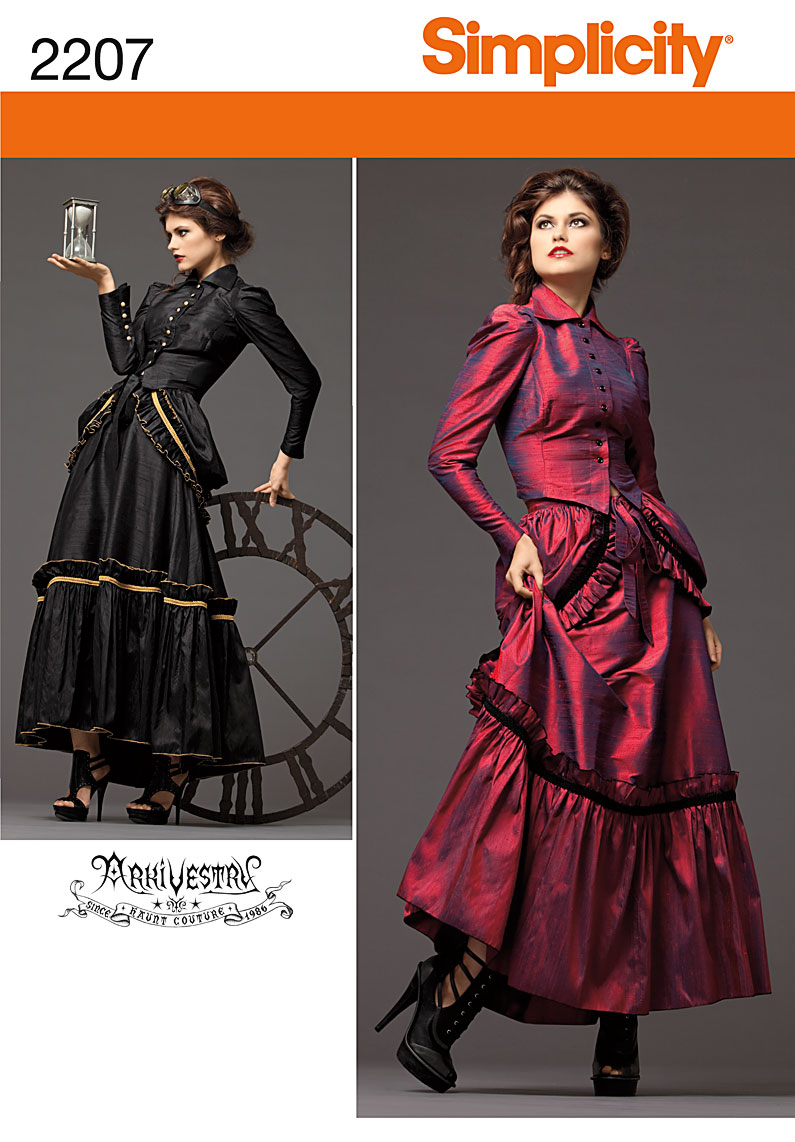
Simplicity 2207 Steampunk Gown

I wanted to make something kind of theatrical to wear to my book signings to really put the audience in a spooky mood.  Ideally, I would like to have made a late Victorian mourning outfit for that.  Unfortunately, in order to do that up right, I would not only have to make the base gown, I would have to have all the proper underpinnings for it.  Realistically, I don't have enough free time to have all that finished by mid-August, so I went with Plan B - Simplicity's 2207, a lovely Steampunk outfit with a very late 1880s/early 1890s feel to it.


I am making it in black acetate taffeta and purple velvet ribbon for the trim.  I appreciated the fact that the skirt has an elasticized waistband in the back, as my waist size has been in a state of flux for the past year.  I didn't pay attention to the pattern instructions and ordered 3/8 inch ribbon for it.  In hindsight, that will not show up as much as it does in the illustration.  Since my color scheme is more muted, it may not make as much of a difference.  I also ordered vintage black glass buttons for it.  I was toying with the idea of using some clock faced buttons I have in my stash, but for my purposes, it's probably better to stick with a faux Victorian look than go full out Steampunk.

I have just started making it and already have an observation.  The flounces and ruffles are designed to be finished using a serger or zig zag stitch.  Since most of what I sew is historically correct reproduction clothing, I never bothered getting a serger.  It would have come in handy big time for this.  I zig zagged the edged once on the #6 width, which on the lightweight taffeta, ended up being more like a #2 width.  I had to go over it a second time to make the color noticeable and to make the finished edge more secure.  The single row of zig zagging felt like it could easily get pulled loose.  Fair warning, you will need a lot of the contrast thread for this.  I expect to go through 2 large spools, possibly more.  I'm going to have to hand trim all the fuzzy edges off of it, too.

Come to think of it, I am in the mood for this general style, having watched the full series of Lark Rise to Candleford recently.  The costuming in that was charming.  The photo below doesn't do the costuming in general justice.


IF I have time, I will be making a late 1880s/early 1990s bonnet to go with it.  I found the perfect pattern offered by Lynn McMasters.  She has some very cool bonnet and hat patterns in general.  If I enjoyed making hats (which I don't), I could have a field day with these.


And if I get really energetic, I would like to make the late 1880s coat from Truly Victorian.  One of the characters in Lark Rise wore something similar to this made out of cotton velvet.  It was worn over a bustle-less skirt, and the extra length included to cover a bustle draped quite prettily in the back.

Wednesday, January 26, 2011

1910 Hat Pattern

After all that searching last summer for a 1912 appropriate hat pattern, it turns out that a friend of mine sells them on her website at Eva Dress.  D'oh!  Well, now I've got the pattern in hand for any future needs.

I have had to slow down on blogging here because I have had very limited time to sew for the past year.  That's actually for positive reasons.  The History Press out of the blue contacted me to write a book about my other love, local ghost stories, and the history behind them.  Look for The Haunted History of Columbus, Ohio to be out in bookstores at the end of summer, 2011.

As soon as it is finished and shipped off to the publisher, you can bet that I will be back to my sewing machine in a heartbeat.  This actually gives me an excuse to make more vintage clothes.  I will have to go to dozens of book signings next fall for it.  What better way to dress for that sort of thing than to wear historically correct mourning clothes from decades past?  I would love to make an Edward Gorey style mourning outfit.

Thursday, December 2, 2010

Old Fashioned Christmas in Columbus, Ohio

In the mood for an old fashioned holiday?  It may be 2010 but there's no reason why you can't travel back in time to experience Christmas 19th century style. The local house museums are all gussied up and ready for visitors.

At the Kelton House Museum and Garden, you can see a fabulous display of Victorian and early 20th century Christmas decorations from the collections of Michael Girard.  Open hours are Sunday afternoons from 1 - 4 p.m. They are also holding special tours for the month of December on Fridays from noon to 2 p.m.  The tours last about an hour, so make sure to get there early.  Admission is $6 and under.   

You are probably familiar with the song "Up on a Rooftop," but did you know that it was written by a composer in Westerville?  Come visit the Hanby House, home of Benjamin Hanby, for a dose of Christmas cheer.  They are holding a holiday open house on Saturday, December 4 and Tuesday, December 7 from 7-9 p.m., and Saturday, December 11 and Sunday, December 12 from 1-4:30 p.m.  Admission is $3 and under, or free to members of the Hanby House or Ohio Historical Society. 

If you are in the mood for something earlier, the Orange Johnson House in Worthington harks back to pioneer days.  They are also having a Christmas Open House on 3 Sundays, December 5th, 12th, and 18th from 1 - 5 pm.  There will be musical performances at 1:30 and 3:30 pm.  Admission is free.

A perennial favorite is the Ohio Historical Society's Dickens of a Christmas event at Ohio Village.  The entire village is decorated in mid-Victorian style, with wandering carolers and costumed interpreters giving demonstrations in the buildings.  This is the most interactive of the festivities, with hands on activities for both children and adults.  The dates are December 10, 11, 17, 18 from 6-9 p.m.  and on December 19 from noon-5 p.m.  Admission is $12 and under.

Please click on the links for more details, and have a wonderful holiday season!

Wednesday, July 21, 2010

The One Hour Dress from 1924

The One Hour Dress (center) and 2 vintage pieces

I needed a dress for a 1920's lawn party but didn't have a whole lot of time to put into it.  I found the perfect solution in the One Hour Dress.  That is a set of instructions created by famed home economics instructor Mary Brooks Picken in 1924 for making a dress in an unbelievable amount of time.  There is a set of videos on YouTube where a seamstress demonstrates this, and yes, you really can make a dress in an hour.  However, it requires techniques like not using pins or finishing the seams that I was not comfortable with.  So, between using the usual sewing techniques and making some modifications to the pattern, it took me more like 4 hours to make.  I met a lady at the lawn party wearing a fancier variation of the dress.  She said it took her an entire week to make.  You can easily spend much more time on it the more detailed you decide to make it.

I have to admit, I really liked being able to make a dress without using a pattern.  Or maybe I just like being able to work on something without the cats dive bombing the pattern and chewing on it while I'm trying to pin it down and cut it out.  The modifications I made were to change the skirt so that it overlaps in front and adding a wide bias cut strip at hip level for interest.  Depending on the fabric choice and trimming, the pattern can end up looking like a hospital gown.  The hip detailing was a good decision in terms of making it look more dresslike.

The end result turned out really well.  It does have a very period look, as of course it should.  Sadly, I only came in second place in the costume contest with it.  The costume that won was a cheesy all over fringe dress worn with a feather boa and a pair of flip flops!  At least I don't have to worry that I didn't win because my dress didn't look authentic enough.

Sunday, June 27, 2010

The 1912 Kimono Dress Completed

Here is the end result of my Sense and Sensibility 1912 Kimono Dress.  Overall, I liked the pattern.  My only issue with it is that the bodice and skirt parts in the back required some easing to fit together.  The cotton broadcloth I was using didn't work too well for that and puffed out a bit.  I also wish that I had either been able to afford the same print that I used for the bodice for the underskirt, or used the underskirt material for the belt to tie it all together better.  Still, the end effect is very pretty.  I got a lot of compliments on it.

Getting a proper hat for the era was a bit of a challenge.  The closest I could find patternwise is the hat pattern from Simplicity's Edwardian duster coat pattern.  The crown on that really wasn't wide and deep enough for a 1912 impression.  I probably could have altered it easily enough, but I really didn't have the time to spend making a hat regardless.  So, after doing some research, I found that a smaller brimmed hat would also be appropriate as long as the crown was fairly deep and wide and the trim was even higher.  I found a nice modern one and some great 4" wide ribbon on eBay.  The Ribbon Store out of Las Vegas is a godsend for historical hat making!    I made a cockade based on the Old Fashioned Ribbon Art book that Dover republished. (Update- hat problem solved!)

I'm pretty pleased with the outfit.

Tuesday, April 20, 2010

1912 Kimono Dress

I had to take my sewing machine in to be fixed. The sewing machine repairman was swamped, so it took 3 1/2 weeks to get my machine back instead of the 3 days that it normally takes. It's nice to see someone getting a lot of business in this economy, but that threw me off schedule. I had to put the 1863 jacket on the back burner and switch to working on another project that I have a deadline on.

The new project is the 1912 Kimono Dress pattern put out by Sense and Sensibility that I am making for a historical presentation in June. I won't take me that long, but since time has a way of getting away from me, I thought it would be smart to get it taken care of. However, this pattern is making up so fast that it almost counts as an instant gratification project. I got it cut out a couple of days ago and should have no problem getting it finished in an afternoon.

One thing to watch out for if you decide to make this pattern - the bodice pattern is designed for 54" - 60" fabric. If they mentioned that in the yardage requirements, I completely missed it. However, that may have only been an issue for me since I made the bodice out of a different fabric than the underskirt.  I may have been able to lay the pattern lengthwise instead of crosswise that way.  Luckily, I was using one of the smaller sizes, so the fact that I was using 45" material only resulted in the sleeves being 3/8" short. Anyone trying to make one of the larger sizes would have a problem, and with medium sizes, the sleeves will be short. There is an option to add contrasting cuff sleeves which could hide some of the shortness.

I think this will turn out nice. I found some era appropriate reproduction fabric from Fabric.com for the bodice in pink and green for the bodice and sash. The rest is broadcloth in coordinating colors. Of course, I will post pictures when I'm done.

Hopefully, I will be able to get back to the 1863 jacket soon. The French blue cotton velvet I got for it is gorgeous, and I found some lovely old gold trim to go with it. Unfortunately, I have 2 other 1920's costume events in June that I also have to get ready for, so it may be on the back burner for a little while longer. Now I remember why I tend to use all my vacation time to hang around the house and do sewing.

Want to see the finished project?  Here's how it turned out.


copyright Nellie Kampmann, 2010

Sunday, March 14, 2010

1863 Jacket Progress

The pattern arrived yesterday, so I went ahead and made the mockup. I was surprised that the pieces all fit together just fine, aside from requiring some easing, as described in the pattern instructions. From what I'd heard of patterns from that time period, they tended to be wildly inaccurate, and were mainly used by seamstresses as a general guide. The patterns are not detailed. They are basically "sew pattern piece A to pattern piece B". The basic construction is pretty simple, so that's not a huge issue. However, there is no mention of, oh BTW, you need to make a lining for this and things like that. An experienced seamstress should have no problem figuring out how to make it, but I would not suggest it for someone who is fairly new to sewing.

It fit me (34" bustline) quite well. It will require 2 yards of outer fabric, with or without nap, and 1 7/8 yards of lining.

Now what to make it in? I was originally thinking of cotton velvet in a color to coordinate with my day dresses. the sleeves will not accommodate the bulk of my day dress sleeves. After doing more research, it looks like jackets of this kind were not meant to go over other dresses anyway. The illustrations inevitably show them over a blouse, sometimes with a vest, and a skirt that is usually made of the same material. The original May 1863 instructions suggest making it out of cashmere,silk, or wool.

Here is an illustration from 1865 showing various jackets. It is from La Couturière Parisienne, one of the best sites I have found for researching high fashion from previous centuries. She has everything from paintings and fashion plates to actual patterns available there. This illustration is a couple of years beyond what I'm shooting for, but it fits with the other research I have done on this.


So, in addition to the usual dithering I have over color, I have to decide whether to make it in a heavier contrasting fabric, possibly to donate to the museum where I work weekends for the docents to wear. That would need to be easily cleaned, which limits my fabric and trim choices. Option 2 is to make it from silk and make a matching skirt. That would also require making a blouse. All that would be a much larger project that I had originally intended for this. Option 3 is to make it to wear to my day job at a archives library, which gives me more color choices, but would again limit the choices of fabric and trim. I'm leaning towards combining Options 1 & 3, making it for work, but also keeping in mind that I could use it with the costumes at the museum.

Tuesday, March 9, 2010

1863 Jacket


Never the kind to have only one iron in the fire, I have yet another pattern on order. This time, it’s for a 1863 jacket from the Vintage Pattern Lending Library.


I am going to leave off the vest part for a couple of reasons. First, I want to wear the jacket as a historic touch with my modern clothing as well as with my Civil War era stuff, and it would work better for that purpose as just a jacket. Secondly, I’m too lazy to deal with adjusting the pattern to fit that much. This was pulled from an authentic 1863 pattern. Patterns of that time period were typically produced for a 32” – 34” bust line and a 22” – 24” waist. Having descended from a long line of 98 pound weaklings, the former is no problem. However, the latter is. Having hit my 40’s and the accompanying middle age spread, my waistline being that small is a distant memory. As in, there’s a reason why I’m starting to develop a love of the clothing styles from the 1920’s.


Anyway, I’m back to my usual dithering. I’m not sure if it will look right over my 1860’s dresses. The sleeves are going to be an issue. Some research is in order there. And if it would work , I would ideally like to make it in a color that would complement both the cadet blue and cream cotton print dress and the aubergine wool dress. I’m thinking it would probably work best in a nice deep green cotton velvet. That has its own issues. I am finding cotton velvet in green, but it’s a more medium tone, washed out version of hunter green. Of course if I can't use it with my dresses, that frees me up to make it in whatever color catches my fancy. The problem may be solved right there. I'll be able to tell more once I get the pattern in my hot little hands.

Saturday, March 6, 2010

My First Steampunk Project


This isn't sewing, but I did complete a pair of steampunk earrings this afternoon.

I wish the gears in the center showed up better so that you could see all of the detail in them. Ideally, I would like to have had larger gears for the center, too, but watch gears are too small and clock gears are too big. But I'm pretty pleased, anyway. It's kind of nice that the dangle part is loose and can swing back and forth. The best part is, the watch faces glow in the dark.

Instant Gratification Cloches


If you ever need an instant gratification historical costuming project, I don't think you could do better than Vintage Pattern Lending Library's H001, 1920's felt cloche hats. All I had to do for the model I made was to cut out three pieces of felt, sew 4 seams, and voila! - instant hat! If I hadn't chosen to hand sew the seams, I could have had the entire thing done in less than an hour. Since it did not require much material, it was also quite inexpensive.

As with all of VPLL's offerings, this is a reproduction of an authentic pattern. In this particular case, it is actually a set of 5 hat patterns that were put out by the Western Felt Works company in order to get people to buy more of their products. The styles range from sporty to sophisticated, and all of them have a certain panache. It's a nice change from the basic cloche that seems to be the standard with other companies. The one I chose actually has a very modern feel to it, so it will look fine with either my period clothes or contemporary ones. I like that they mention what colors were in fashion in the instructions. Better yet, the hats are simple to make. In the instructions for the one I made, there was a step left out of the instructions, but it was easy enough to figure out.

The only real challenge I had was to find the right material for it. I wanted to make mine out of historically correct 100% wool felt and found the pickings on that to be mighty slim. When I did find a source, the dimensions of the piece turned out to be a squared 18" by 18", unlike the 9" x 32" elongated rectangle assumed in the instructions. I was barely able to fit the pattern on to the piece I bought. If I had wanted to make the larger size or one of the other hat patterns I would have had to buy 2 pieces of the felt. One of the pieces for view 2 is so large that it would not fit at all on the felt square I had. Be prepared to piece together your felt cloth in order to have a large enough section if you can't find the right width of felt. It looks like there are bigger pieces being sold now than were available when I ordered mine, though.

The end result is a nice, unlined felt cloche. I have made cloches before from other pattern companies and found the fit to be too tight. I mean, cloches are supposed to be close fitting and designed for short bobbed hair, but these were a bit too snug even with those considerations. In the case of this pattern, however, the 22" size fit my 22" head just perfectly. Please note that if you are buying it for the 23" head size, the pattern pieves themselves are for the 22" size with instructions to add a certain amount to the seam edges to make it for a 23" size.

Not that I really need more than one cloche, but I will no doubt be making a couple of the other views, too. When it's this easy and inexpensive, heck, why not?

Thursday, March 4, 2010

Steampunk!

In the 1990’s, there was a short-lived science fiction/Western tv series called Legend that is one of my all time favorite shows. The premise was that a Jules Verne-esque writer of Western dime novels paired up with a character based on Nikola Tesla who could bring the scientific inventions he imagined in his books to life. It was set in 1876, one of my favorite periods for women’s fashion, so that was a plus. The series was a delightful mix of adventure, quirky humor, and gorgeous costuming, and it really captured my imagination.

Fast forward a decade or two, and I discovered the old BBC series Bramwell. Bramwell is set in the mid-1890’s. That isn’t a time period that normally fascinates me, but after watching many hours of the show, the look is starting to grow on me. It doesn’t hurt that Butterick re-released some of their original patterns from that era, and I was able to get them on sale for dirt cheap. My day job is in a historical society, so I can get away with wearing historically inspired clothing without folks thinking that I am too eccentric.

And now, here I am discovering this trend of steampunk fashion. Yeah, I know I’m late to the party, but I don’t claim to be hip. I’ve known about it for several months, but what finally hooked me was seeing the wonderful pieces of steampunk jewelry designed by Kay on her Pizazz Beads website. I can’t say that they ever wore anything like that on Legend, but the general feel of the pieces reminded me of that series.

It should be no big surprise what my next project will be. The timing on my interest in this is impeccable, too. Fabric.com just got in a huge shipment of 100% cotton dotted swiss lawn and plain lawn. They are already sold out of white and the softer colors, but they also have some bolder colors that are also quite historically correct for the 1890’s. I have already amassed a small stockpile of steampunk jewelry beads and findings from Pizazz, so I am raring to go.

Tuesday, January 19, 2010

The Whoops List

I plead guilty to being one of those costumers who, in the rush to complete a project for an event, doesn’t quite get everything done, then forgets to go back later and finish it up. This is biting me in the butt in a minor way while trying to get ready for a ball.

One of the local Civil War reenactment groups is having a ball at the end of this month that is open to the public. This delights me to no end, as I have been hoping to have an excuse to make a ball own at some point. I only found out about it 3 weeks in advance, though, which was not enough time to get appropriate fabric and make a ball gown for it. So now I am trying to make my best day dress as suitable as possible for evening wear. It is a raisin colored wool dress with trim in violet silk velvet – very elegant, if I may say so myself. It’ still a little staid for evening wear, even with the flowered headdress I am making for it, but the historic fashion police will probably understand that folks who aren’t heavy into reenacting probably don’t just happen to have proper ball gown or evening dress lying around. It getting it prepped for the ball, I realized that I never did get around to making a belt for it. At the time I originally made it, I was having trouble finding a historically correct belt buckle for it. The dress is acceptable without a belt, except for the fact that it strains a little at the bottom of the bodice, showing the hooks and eyes. I have since found a decent buckle at an antiques fair, so that’s on my to-do list for the weekend. It’s not a huge deal, but I wish that I had gone ahead and made the belt when I wasn’t under any time pressure.

A bigger issue is that I did not use horsehair braid on the hem, and the hem is starting to wear. That’s not a huge problem, as the hem could stand to be slightly shorter, anyway. I just am not looking forward to al the work involved in ripping the current hem open, sewing on the horsehair braid, and re-hemming the whole thing. This will have to wait until after the ball.

Another thing I have to plead guilty to is using a purchased bridal quality hoop skirt for the dress, again, due to time constraint from the event I made it for originally. It has an elastic waist which has suddenly lost all of its elasticity, a fact that became sadly apparent to me when I was docenting this weekend. Ideally, I will be cutting it apart, reusing the hoops and combining them with a couple more for a sturdier item, and making a new cage crinoline. Again, this will have to wait until after the ball. On the plus side, the smaller hoop skirt that I had made for another dress needs some parts to hold the hoops together better. I didn’t need any other supplies at the time I realized this, and couldn’t place an order for just $2.50 worth of parts. This gives me a reason to place an order for more supplies, so I can kill 2 birds with one stone.

And my final oops was the realization that when I made my mourning gown, I ran short of time and hadn’t made a collar for it. I borrowed the collar from my plum dress, which became an issue when I realized that 1 hour before I was supposed to leave for my docenting shift over the weekend. Thank heavens for little safety pins. The collar is interchangeable, but it would be nice not to have to worry about shifting it back and forth between the dresses. One more thing for the to-do list.